


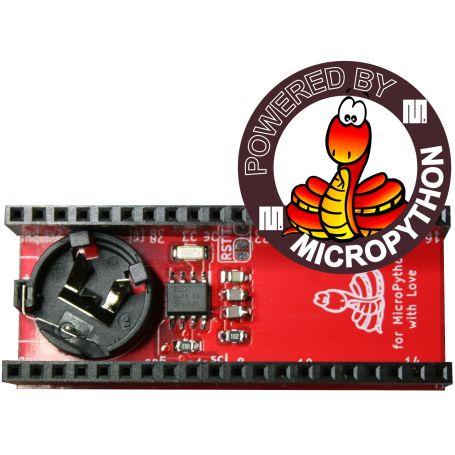


Pico-Clock-Boot: PCF8523 RTC board for Raspberry-Pico
RTC Clock for Raspberry-Pi Pico
- PCF8523
- 32768 Hz Crystal
- Expansion for Raspberry-Pi Pico
- MicroPython ready

Payments are secured by LyraCollect, a French payment collection company.

It is possible to delivered to your home, to a pick-up point or picked up by appointment at MCHobby

We prepare, pack and ship your orders with great respect and care.
A PCF8523 RTC clock for Raspberry-Pi Pico
The Pico-Clock-Boot is a real-time clock for Raspberry Pi Pico. Its form factor (Pico-xxx-Boot) allows it to be plugged directly into your Raspberry Pi Pico.
The RTC clock and its coin cell battery (CR1220 not included) allow the microcontroller to maintain accurate timekeeping even during power outages. Once power is restored, your program simply needs to access the PCF8523 RTC clock to read the time. Time continues to be recorded on the PCF8523 thanks to the CR1220 battery.
The PCF8523 also allows for simple or repeating alarms (repeat every hour, day, etc.).
This extension is ideal for datalogging applications, clock projects, alarms, time control, etc.
The PCF8523 RTC clock is accessible on the I2C(1) bus at address 0x68. This is the I2C bus used as standard by MC Hobby via pins sda=gp6 and scl=gp7.
The clock's interrupt pin (rtc_int) can be connected to pin gp5 of your Pico via the jumper located underside the board (simply apply a drop of solder to close the contact).
Of course, MCHobby offers a MicroPython library to help you get started quickly with this expansion board. Arduino enthusiasts will have no trouble finding a PCF8523 library online.
Notice: a cell coin must be inserted for the PCF8523 to work properly. The PCF8523 does not always say "I'm present" while doing I2C bus scan (but will reply to other usual I2C requests).
Technical details
RTC PCF8523 RTC clock.
- Resolution: Year to Seconds
- Availability of Year, Month, Day, Hour, Minute, Seconds and day of week.
- Programmable Alarm and Timer (with interrupt capability)
- Power: 1.1V to 5V (3.3V for Pico-Clock-Boot)
- Coin battery: CR1220 3V.
- CR1220 current: 150nA
- Configurable charge capacitor for the oscillator: 7 or 12.5 pF
- Frequency adjustement with offset register.
Crystal
- Crystal: 32768 Hz
- Load Capacitance: 12.5pF
- Tolerance: +/- 20ppm at 25°C (standard)
- Temperature coefficient (Beta): -0.034 +/- 0.006ppm/°C²
- Aging: +/- 3mm max (1rst year)
Tutorials
The mpremote MicroPython tool can be used with the command mpremote rtc --set to set the internal microcontroleur time with computer time.
Then, using the trf_date.py example script can transfert the microcontroler time to the RTC pcf8523 clock. Voila! the RTC is set at the proper time.
- MicroPython support for the PCF8523 (MCHobby Github, English/French).
Update RTC time, set the alarm, reach the RTC attributes.
- Interface : Connector
- PICO
- Interface : Bus
- I2C
- Interface : Logic
- 3V
- Library
- MicroPython